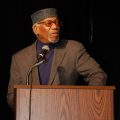
Like many of those who will recall memories of David Rambeau in the wake of the recent memorial, I remember my first days with him and so many subsequent unforgettable moments. A fresh one came to mind when I learned he had joined the ancestors on November the first, a birthday I share with my wife. He was 91 years old and left a magnificent legacy in various endeavors, most notably in the theater and television.
The last time I saw him, by happenstance, occurred in 2017 when I was in town to participate in an Open Society conference at the Westin Book Cadillac Hotel. (It was very much like the chance meeting we had three years earlier at the Charles Wright Museum, and I captured that occasion with a photo that can be found in my book, Black Detroit.) During a break I bumped into him in front of the statue of Alexander Macomb. The irony of meeting him there, one a notorious slave master and the other a noted civil rights activist, was not lost on either of us, and we commented on its fortuity among other things.
He didn’t share my enthusiasm about attending the conference, dismissing it with his usual Black Nationalist ardor. It was in keeping with the David I had come to know for over fifty years, beginning during his days at the Concept East Theater, where often exuded a matchless competency on the stage. In the late ’60s and early ’70s, when I taught at Wayne State University, I invited David to either lecture or perform for my students, and he chose to, along with his wife, Vonnie, do an interpretation of Dutchman by Amiri Baraka (née LeRoi Jones). They were both remarkable.
A few years later, I offered David a teaching position with me at Monteith College, where he was part of a team-taught course, including Gloria House (Aneb Kgositsile), and Ernie (Mkalimoto) Allen. He wowed the students with his history of the Black theater and challenged them with thoroughgoing assignments.
There were several years of separation, and I mainly heard of David’s activities from his brother, Richard, or occasionally from his television show For My People, where I often made guest appearances.
I will never forget his commitment to the community, basically funneled through his creation of Project B.A.I.T (Black Awareness in Television). David, no matter what the context, did not suffer fools gladly, and never relinquished his passion for Black self-determination.
From a distance, I kept in touch with him via the internet and his outspoken positions delivered online, particularly his concern about the Black theater debates surrounding the curriculum at Wayne State.
Right to the end of his life, David was as combative as ever, fervently involved in Black education, especially Black literacy, and many of the last emails I received from stressed these pursuits.
No doubt about it, he will be missed and always remember his famous quote: “Teams win!”