

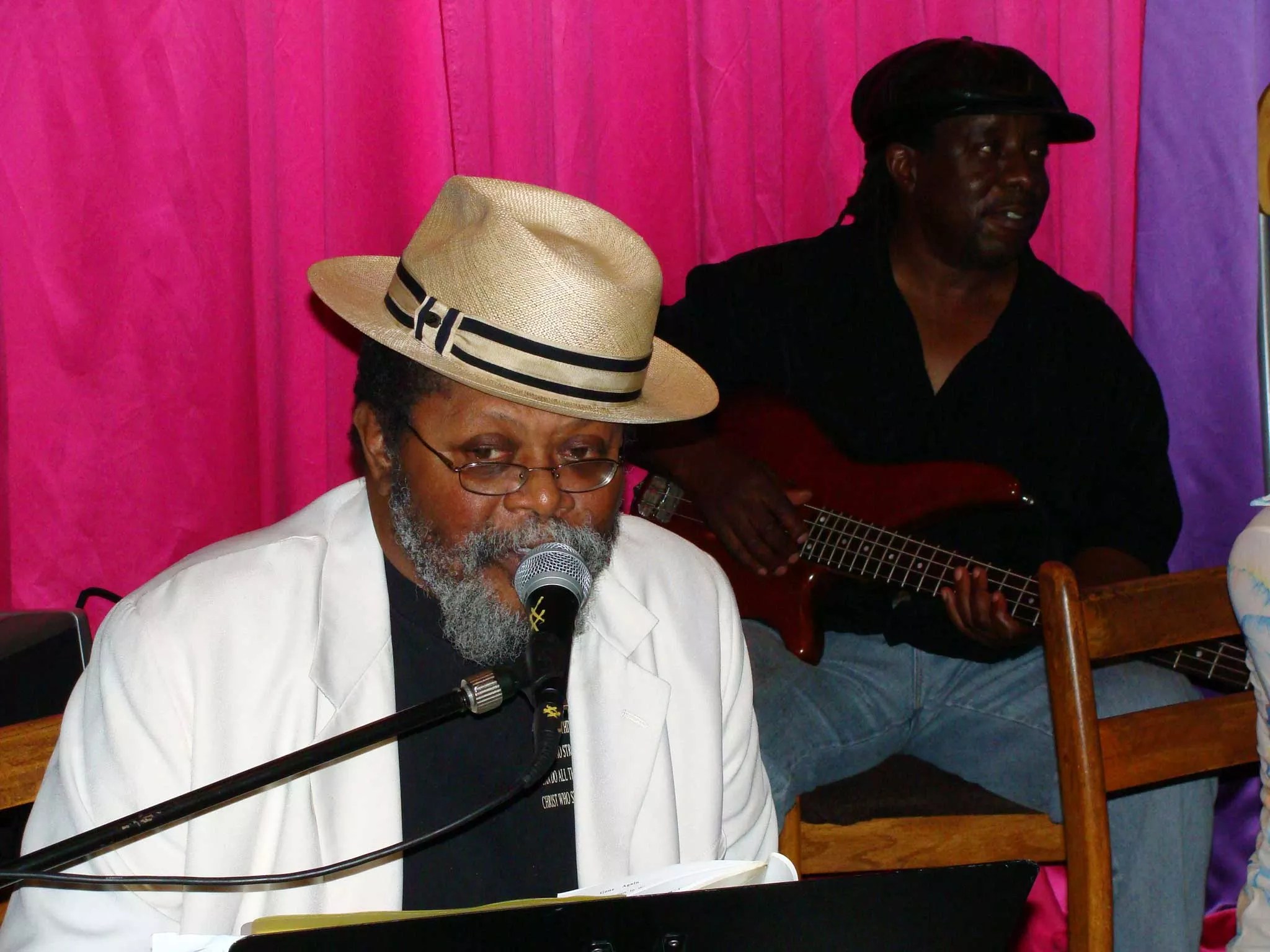
Many in Detroit’s Cass Corridor scene of the 1980s and ’90s knew Ron Allen not only as a groundbreaking poet and playwright, but also as a pillar of the community. To them, he was a generous cook, a sobriety mentor, a Buddhist spiritual leader, a Vietnam War vet, and most importantly, a good friend. After moving to Los Angeles in 2007 to further pursue his artistic career, Allen died in 2010 at age 62 following a stroke.
But now, a group of Allen’s friends in Detroit has set out to memorialize him with a new multimedia exhibit that opens at the Kayrod Gallery at the Hannan Center later this month. The Ron Allen Project includes a gallery show of photos and artwork, film, an open mic, and a live performance of one of his never-before-seen plays. A documentary is also in the works, which has recently tapped Daniel Land, director of last year’s America You Kill Me film about gay rights advocate Jeffrey Montgomery.
A son of the East Side, Allen found community among the artists of the Cass Corridor after returning from Vietnam, at a time when a population exodus from the city was hollowing out its neighborhoods. “There was something that happened in the transition between being in the war to coming back to Detroit,” says Carla Harryman, “and Detroit wasn’t the same and in many ways was worse than what he had left behind.”
In 1982 Allen co-founded the Horizons in Poetry arts collective, and in 1997 launched the acting company Thick Knot Ensemble. In this time he also served as a mentor for fellow addicts at places like Mariner’s Inn and Sobriety House, as well as a chef at restaurants like the Cass Café and Union Street.
In his poetry, Allen found inspiration in the hardscrabble people around him, and his work as a playwright was a natural extension of his poetry, the project organizers say. “He started off with taking poems, and just sort of making them into dialogues between a couple of characters on stage,” says John Jakary. “And they were just short vignettes. The first two plays didn’t have a whole lot where there was a throughline, other than maybe some themes about capitalism, or race relations, or interpersonal relations. They didn’t hold together necessarily as a beginning, middle and end. But as he got more comfortable with writing for that form, we can see that there were themes that were starting to run from start to finish. And he would actually try to carry these ideas through still in different vignettes in different ways.”
In Ritual of a Dead Planet, a Playboy centerfold comes to life and gets in an argument with a Black man. The Heidelberg Project: Squatting in the Circle of the Elder Mind is based loosely on the life of Tyree Guyton, another Detroiter who sought to heal his community through art after returning from a stint in the Army.
“He was very interested in spaces of exploitation of people, of human bodies, of distractions that were destructive,” says Harryman, adding, “I think that’s a major thing, the difficulty of returning to some sort of sense of being grounded when one’s confronted with so many kinds of distractions, often that come out of poverty, but also just come out of commercial exploitation.”
“He was constantly on a quest for a deeper and more authentic or creative way of being and understanding reality, like almost no other human being I’ve met,” says Jim Perkinson. “His passions were never anchored in convention or something that was supposedly normal or taken for granted.”
After returning from Vietnam, Allen was also diagnosed with schizophrenia, and those who knew him say that his plays were a way to cope with his mental illness. “His idea was he wanted to just portray schizophrenia on screen or on stage, and so there are a lot of these jarring things that happen in the script,” Jakary says.
His condition also led him to seek and maintain strong friendships. “I feel part of his personal way of dealing with what some might say ‘voices in his head’ is he would call people many times during the week,” says Ruby Woods. “And these were not just fluffy conversations!” Harryman adds.
Related

In the years after his death, Allen’s friends resolved to create some sort of memorial to his life. What became the Ron Allen Project began in 2015 with the initial idea to produce one of his plays. “We were like, OK, it would take a whole bunch [of money] to produce one of his plays, but maybe if we make a documentary film about him that would be a start,” says Woods. They began pitching the idea at fundraising events like Detroit SOUP and to the John S. and James L. Knight Foundation.
The foundation’s Knight Arts Challenge rejected the proposal multiple years in a row. In 2021, the local website Model D published an article about the project, and in the 11th hour that year, the Ron Allen Project pitched the Knight Arts Challenge once more. Perhaps thanks to the Model D article and the Ron Allen Project’s social media presence, this time it was successful, and was awarded a $25,000 grant.
The Ron Allen Project exhibition will be held from Sept. 22-30 at the Kayrod Gallery. It will include a presentation of The Hieroglyph of the Cockatoo, one of the last plays that Allen was working on before his death.
“I can’t say for sure how he felt about it,” says Jakary, who has directed many of Allen’s plays. “He had been writing all of these scraps, and we were piecing them together. He kind of thought of it more as a screenplay. So there’s still a lot of stuff in there that was related to video and stuff like that.” Jakary describes the presentation as more of a “staged reading” than a full-blown production.
Most importantly, organizers say they hope to keep Allen’s legacy alive.
“He’s one of the best poets to come out of the Cass Corridor, bar none, a playwright who managed to take poetry and put it on stage in ways that were sometimes mind-blowing,” Jakary says. “And just a man who wanted to make a community for himself and worked really hard, at least for as long as I knew him, to do that.”
More information is available at ronallenproject.org.
Subscribe to Metro Times newsletters.
Follow us: Google News | NewsBreak | Reddit | Instagram | Facebook | Twitter
Related Stories

#/media/File:Ron_Allen_with_Code_Zero.JPG)
2023 metro Detroit fall arts guide
This article appears in Sep 13-19, 2023.