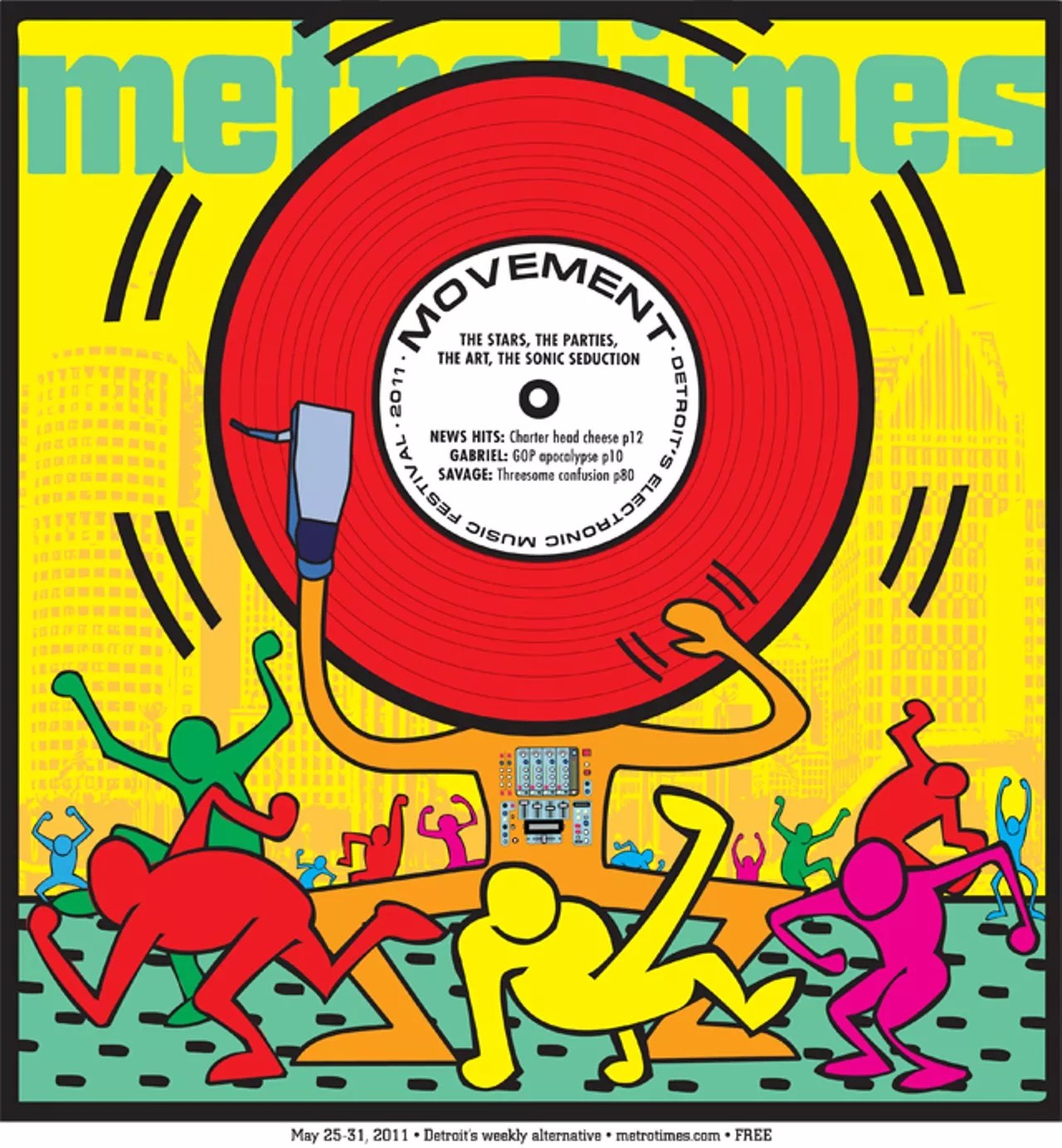
A holiday for electronic music fans the world over, Movement Electronic Music Festival returns to Detroit’s Hart Plaza. As always, there’s a lot to take in, and this year boasts one of the fest’s most eclectic, diverse lineups yet. We usually make the event our cover story so to commemorate it, let’s look back at all our past Movement covers.
It’s finally here. It’s the long-running fest’s 19th year as a Memorial Day Weekend tradition, and 13th year under the management of party promoters Paxahau — an institution at this point, and a well-oiled machine at that, too.It’s true. You don’t have to look beyond our own backyard for some of the most innovative electronic artists working today. Nearly 40 acts on the bill in 2018 hailed from metro Detroit, many of whom pretty much created the damn scene (we’re looking at you Carl Craig, Kevin Saunderson, and Stacey “Hotwaxx” Hale).We geeked out over the artful, moody cover from two years ago, which also happened to include Pantone’s 2016 color(s) of the year: rose quartz and serenity. In 2017, Detroit’s electronic music festival was dominated, as ever, by DJs. But of the more than 110 scheduled sets at that year’s festival, the word “live” was on 22 to 23, if you count the performance by Rebekah who was billed as playing a “hybrid set” combining live performance and DJing.This was the 10th year that Paxahau was running Movement, and it really was a crazy good lineup, headlined, of course, by Detroit dance music spiritual forefathers, Kraftwerk. It was a real return to form to us, with a super cast of international and local performers who veer from the experimental to the straight-ahead.At this point the festival had grown into its adolescent years and was now revisiting that spirit that carried it from its initial inception. The city, too, found itself with one foot in the past and the other in the present. While both newcomers and locals traveled to the fest each year, it was important not to forget those roots: a brash group of people set on performing music that defined a city for them and attracted thousands to a raucous reverie where memorable moments happened at a heartbeat.From deep house to new-disco, from techno to dubstep — no matter what your choice of subgenre, there was something at 2014’s Movement to get a techno fan dancing like a puppy on a trampoline. As well as the vast numbers of festival-goers already living in metro Detroit, about half of the attendees came in from other states, as well as Europe, South America, and Australia. By that point, Movement had become an annual pilgrimage for electronic music aficionados, and the lineup didn’t disappoint.Some of the biggest names from the electronic music world would be here in 2013: from our own Carl Craig and Richie Hawtin to the likes of Moby and John Digweed. Movement was and still is the closest Detroit gets to “Woodstock” — the festival is a celebration of peace, love, and dancing. People pulled out their craziest threads, got down to Hart Plaza and — goddamnit — danced.Life tends to move very quickly when you’re living it loud, at 150 beats per minute, on a concrete dance floor with 1,000 other bodies. One year feels more like three or four or five at this speed. No wonder I feel like I’m that baby who becomes an old man within seconds in the final frames of Kubrick’s ‘2001: A Space Odyssey.’ But living in the future music, man, still feels good, nonetheless, because it is good. No, make that great. Nah, try awesome.Movement is all part of a celebration of a scene that revolutionized (in part, let’s not get too carried away) society and culture by applying various technologies to dance music. Simple as that? Yes, basically.The fundamentals of the way we move together were altered by the synthesis of sound and human energy. And nowhere were they applied with as much dedication and sheer force of will than in Detroit. It’s a place that has survived the bloom and wither of industrialization, and it’ll take more than mere rapture or apocalypse to bring us down.In 2008 Detroit once again opened up its ashtray heart to bring progressive music lovers the ninth edition of the Detroit Electronic Music Festival (aka DEMF, of course) — previously known to the world as Movement (2003-04), Fuse-In (just one year — 2005 — thank God), and now Movement: Detroit’s Electronic Music Festival (since 2006). Around these parts, though, we just call it “the festival,” which certainly trumps that mouthful of previous mushy qualifiers. It’s a bountiful mess of activity dedicated to dancing or just drifting to music made with synthesizers, samplers, drum machines, computer software and anything else vaguely electronic.The 2007 cover rightly showcased the one and only Jeff Mills. As we sit here pondering the fury that will take over Detroit over the next few days, we pause to reflect on how the festival has always been for everyone: techno lovers and haters; whiners and quibblers; ecstatic dancers and third millennium hippies; club crawlers and starry-eyed house heads; chin-scratching aesthetes and purists; assorted suburban high-school nerds; punkettes and furry ravers with angel wings and bunny ears. And hello to all our local fans and musicians, as well as visitors from New York, London, Paris, Berlin, Tokyo and anywhere else on the planet where “Detroit music” remains synonymous with “the future.”
Since 1980, Metro Times has been Detroit’s premier alternative source for news, arts, culture, music, film, food, fashion and more from a liberal point of view.
More by Metro Times editorial staff