Detroit’s rebirth is a hot topic, both in local and international news. Its “comeback” narrative is one that appeals to many and we all love watching as the city returns to prominence, to that beloved moniker, Paris of the Midwest.
But, to understand its recent renaissance, it helps to know the city’s rich history.
Through these photo montages, one get can get a sense of not only the work that has been done, but the work that remains to be done.
Editorial interns Mallary Becker and Malak Silmi contributed to this slideshow.
The Fort Shelby Hotel Ballroom
2006 and 2017
This hotel opened in 1916 and doubled in size 10 years later. After changing hands multiple times the building was abandoned in 1974, but was added to the National Register of Historic Places in 1983. The hotel was known for its crystal ballroom, which held many concerts, weddings, and special events. Thankfully, the hotel was bought in 2007 and underwent a $90 million renovation in just one year. Now, the Doubletree Guest Suites carries on the tradition.
Photos via historicdetroit.com and weddingwire.comThe Book-Cadillac Hotel
2004 and 2008
Located in the heart of downtown Detroit this hotel was once a symbol of grace and beauty for its neo-renaissance style — Martin Luther King Jr. called it “a pearl in a sea of turmoil.” It shuttered in 1984, and after being abandoned and left to rot. In the early 2000s it underwent a $190 million renovation and re-opened in 2008. Now, the Westin Book-Cadillac is once again a premiere hotel in the city.
Photo via historicdetroit.com
Photo via dwyermarble.comOrchestra Hall
1970 and 2013
Now known as the Max M. and Marjorie S. Fisher Music Center, this building was the first home to the Detroit Symphony Orchestra. The DSO left 20 years later and it became a jazz club. It was abandoned until it was listed on the National Register of Historic Places in 1971. The DSO moved back in 1989.
Photo via detroiturbex.comEastown Theatre
1973 to 2015
Eastown Theatre opened in 1931, and by 1969 began hosting acts like Alice Cooper, Jefferson Airplane, and Fleetwood Mac. The ’90s brought the rave scene with the building showing clear signs of decay. Abandoned in 2009, a fire in the attached apartments destroyed half the building in 2010. Scrappers gutted the place and it was finally demolished in 2015.
Photo via historicdetroit.org
Photo via Detroit Free PressRansom Gillis House
2011 and 2017
Once an enclave for Detroit’s wealthy elite, the neighborhood of Brush Park and its victorian mansions were suffering by the 1930s. Built in the late 1870s, the Ransom Gillis House is one of the last remaining houses on Alfred Street, which was all but abandoned after the WWII. Before 2015, all attempts of renovating were not successful. In 2015, Nicole Curtis began renovations on the home, which has since attracted many tourists into its lavish quarters.
Photo via www.detroityes.com
Photo via www.Mlive.comSt. Albertus Church
1900s to 2017
During its heyday, St. Albertus Catholic Church, located on St. Aubin Street, was the spiritual and social center of the Poletown neighborhood, once home to over 40,000 Polish immigrants. Today, just a handful of Poles remain on St. Aubin Street, though the church has been saved by a historic association and holds mass at least once a month.
Photo via http://raulersongirlstravel.com
Photo via www.pinterest.comAerocar Company Factory
1910s and 2018
In the early years of the auto industry, hundreds of manufacturers came and went, as entrepreneurs established small factories and tried to gain a foothold in the crowded market. Most of the names, like Brush, Krit, and Miller, lasted only a few years before closing shop or merging with other companies. Aerocar was one of them, producing cars at this factory on Mack and Beaufait from 1906 to 1908. The building was then sold to the Hudson Motor Car Company, which used it from 1909 until moving to a much larger plant in 1912. Today, it sits abandoned.
Photo via http://detroiturbex.com
Photo via www.google.com/mapsSojourner Truth housing projects
1942 and 2017
In 1942, fights broke out as white residents tried to prevent black residents from moving to the Sojourner Truth homes. Though no one was killed, 40 people were injured, and over 200 were arrested — mostly black people. Moving was halted while officials tried to work out a solution. The houses were later converted to apartments, which are now available for rent.
Photo via http://reuther.wayne.edu
Photo via http://www.dhcmi.orgWoodward and Charlotte Street
1943 and 2017
A time period of rough racial tensions followed the disturbance at the Sojourner Truth Housing in which white residents tried to prevent black residents from moving in. The civil unrest would continue as some of the worst uprisings in American history.
Photo via Wayne State University
Photo via www.google.com/mapsHarper Theater
1941 and 2017
The Harper Theater was built in 1939 on Harper Avenue and Chalmers. In 1973, the theater became a venue for heavy metal concerts and was renamed Harpo’s, necessitating a change to the neon sign. Harpo’s continues to operate to this day as a club and music theater, attracting bands and crowds from across the state and nation.
Photo via www.metrotimes.com
Photo via http://detroiturbex.comThe Grande Ballroom
1928 and 2013 and future plans
In its heyday, the Grande Ballroom was the place for young Detroiters seeking raw rock ‘n’ roll. The building closed in 1972, and vandals have done serious damage to the interior. In 2006, signs for Chapel Hill Church showed up, but not much progress was made. However, in November, 2017 a Gofundme campaign was created for renovations.
Photo via historicdetroit.org
Photo via google maps
Photo via gofundme, Leo EarlyFire Engine 22
Detroit Fire Engine Company 22
1900s and 2017
One of the first fire houses in the city, Fire Engine 22 operated for nearly 90 years before closing in 1983. It was given another life in 1991 when a local couple bought the building and turned it into a Mexican restaurant. After less than 10 years, it closed and the building has been vacant ever since. With the help of some minor work done in 2009 the building still stands.
Photo via detroiturbex.com
Photo via google mapsPackard Motor Car Company
1930s and 2017
Though the Packard name is mostly forgotten now, it was one of the most significant early automobile marquees to settle in Detroit. From 1903 to 1954, Packard produced luxury and mid-price cars at its factory on East Grand Boulevard. Arte Express bought the site and will begin reconstruction in the spring of 2018, transforming it into a restaurant and brewery.
Photo via Metro TimesThe Metropolitan Building
1925 and 2017
During its heyday, this structure was a thriving workshop to dozens of industries, most notably jewelers. Due to urban sprawl, the Gothic style building closed in 1978. In 2017 plans were set to turn the building into an extended stay hotel. It is expected to open in the summer of 2018, after nearly 40 years of vacancy.
Photo via historicdetroit.org
Photo via detroit.curbed.com, Michelle & Chris GerardWestminster and Goodwin Streets
1967 and 2013
Located in the North End, this is a section of the city that suffered significant damage during the riots. Most recently, an urban farm was established in the neighborhood.
Photo via Detroit Historical Society
Photo via Google MapsSt. Agnes Church and School
1980 and 2012
Located in the Lasalle Garden Neighborhood, this is one of the most well known abandoned churches in the city. The massive church could hold 1,500 people and hosted Mother Theresa in 1981. It closed in 2006 and its interior rapidly declined. It currently touts barbed wire and surveillance cameras.
Photo via Metro Times
Photo via detroiturbex.comCollingwood and Hamilton Streets
1967 and 2015
This intersection found on the city’s North End is a stretch of neighborhood that was destroyed during riots. It remains largely vacant.
Photo via Metro Times
Photo via Google MapsSeneca St. and Moffat Ave.
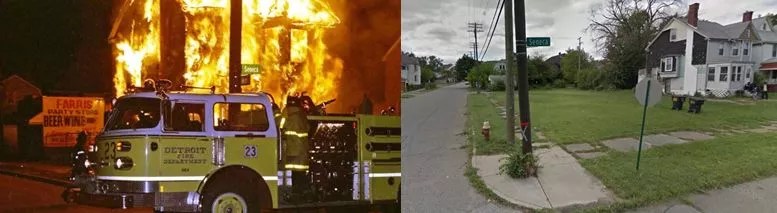
1984 and 2013
More and more people began moving out of the city in the late ’70s, leaving behind vacant buildings, which quickly became prime target for arson. Peaking at 800 fires in 1984, the city implemented extra patrols and encouraged neighborhood watch programs. In 2017, with 54 fires reported during Halloween, the city voted to eliminate its “Angels Night” efforts.
Photo via maskmagazine.com
Photo via Google MapsDequindre Cut
2008 and 2016
Formerly a trench left behind by a rail line that connected industries to the riverfront, the Dequindre Cut is an urban greenway that stretches two and a half miles between Gratiot Avenue and Atwater Street. The original two-mile stretch opened in 2009, an additional half-mile was added in 2016 to connect the original path to Eastern Market.
Photo via Metro Times
Photo via Curbed DetroitChalmers Motor Company
1908 and 2018
Chalmers debuted in 1908 with a popular line of low-price cars. A new factory was built along the south side of Jefferson Avenue in 1907, and though the company enjoyed strong sales early on, it was eventually bought out by Maxwell in 1922, which itself was absorbed by Chrysler in 1924. In later years, the Chalmers plant was used for final assembly of Chrysler cars and trucks, until it was demolished in 1991.
Photo via www.detroityes.com
Photo via Google Maps12th Street/Rosa Parks Boulevard
1967 and 2018.
Racial tensions boiled over again in July of 1967 after a botched raid by the Detroit Police Department on an after-hours bar located at 12th Avenue (Rosa Parks Boulevard) and Clairmount Street. In the picture above, looters ransack businesses along 12th Avenue in the early hours of the riot. Today, the same intersection is a residential neighborhood.
Photo via the Detroit Free Press
Photo via Google MapsDunbar Hospital
1922 and 2014
The Dunbar Hospital was the first hospital in Detroit for black residents. At a time when black people could be denied healthcare at hospitals on account of their race, minority-owned and operated hospitals like Dunbar filled a critical need in the city. Dunbar Hospital would later move to a larger location in 1928, with the original building reverting back to a home and later becoming a part of a historic district.
Photo via University of Michigan
Photo via motorcitymuckraker.comMichigan Central Station
1900s and 2017
In its days of grandeur, thousands of passengers bustled through this station. Historic Detroit calls it the “Ellis Island” of the Midwest. Opened in 1913 and closed in 1988, the Corktown icon and its undecided fate loom over the neighborhood. It was recently opened up for Crain’s Detroit Business’ Detroit Homecoming celebration, giving us a peek into the 100-year-old building.
Photo via historicdetroit.org
Photo via clickondetroit.comOld Highland Park High School and Community College
1900s and 2012
This space had multiple expansions, including the addition of a junior college to accommodate the growing number of students, which peaked at 3,000. The high school became a community college from 1977 to 1995, but ensuing financial troubles resulted in the school’s closure. Later is became a center focusing on dental and automotive trades. The center closed in 2009 and the building was left vacant. Two police cars were placed outside the building to ward off vandals but the cars were damaged too.
Photo via detroit-ish.com
Photo via detroiturbex.comSoutheastern High School
1967 and 2017
The school, built in 1917, had the highest enrollment in the state following WWII, but the number of currently enrolled students lingers around 300 students.
Photo via Walter P. Reuther Library
Photo via Google MapsChevrolet Gear and Axle Plant
1945 and 2018
The automotive industry brought a surplus of people and jobs into Detroit. Some may say too many, which resulted in the inability to maintain the industry. During the Chevrolet Gear strike of 1945 workers demanded a pay increase to maintain the cost of living. General Motors refused and the strike lasted 113 days. This plant was sold and renamed Detroit Gear & Axle Plant. It closed in 2012.
Photo via Google MapsAlfred Street and Brush Park
1900s and 2015
One of the land’s original owners, Elijah Brush sold and divided these plots, but held very high standards for the houses, thus creating the neighborhood of enormous Victorian homes that still stands today. As white flight propagated Detroit’s decline, the neighborhood fell into disrepair and was all but vacant by 1960. In 2015, the city, along with individual developers, planned to renovate the neighborhood.
Photo via Flickr, Scott Weir
Photo via Google MapsBoston Edison neighborhood
1900s and 2015
This neighborhood was established around 1905, and was home to many prominent Detroit figures and families. Today, the 36-block district is still known for being home to large, ornate, historic houses.
Photo via Detroit News
Photo via Curbed DetroitLinwood and Hazelwood streets riots
1967 and 2018
A standoff during the 1967 riots took place on this streets in Detroit’s North End. The intersection is empty now.
Photo via Metro Times
Photo via Google Maps
Since 1980, Metro Times has been Detroit’s premier alternative source for news, arts, culture, music, film, food, fashion and more from a liberal point of view.
More by Metro Times editorial staff