The city of Detroit was founded on July 24, 1701 by French explorer Antoine de La Mothe Cadillac.
Over the centuries, our beloved city has changed tremendously, for better and for worse.
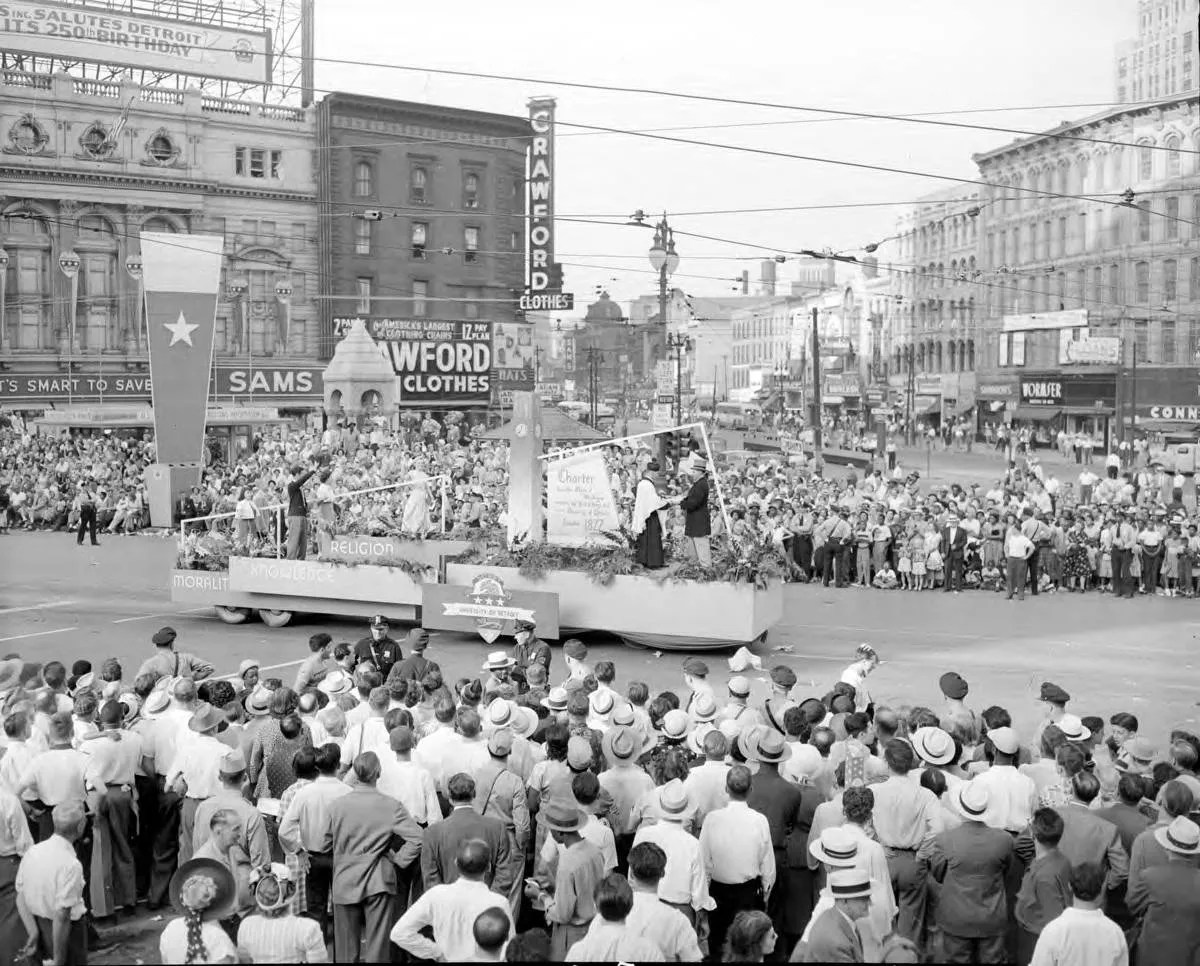
In 1951, however, Detroit was thriving. The year marked the city’s 250th birthday, and the occasion was celebrated with grand festivities from July 22-29. The streets were packed with people, President Harry S. Truman came to town, and an estimated one million spectators watched a four-hour parade featuring many unique floats.
Other highlights of the celebration included a four-story cake in Grand Circus Park, the Major League All-Star Game at Briggs Stadium, and a large pageant with numerous performances.
Now, fast forward 73 years later, Detroit is turning 323. And even though we love the city, we almost forgot. To mark the occasion, we’re taking a nostalgic look back at the epic 1951 celebrations and lowkey hoping the city can host another Detroit-style extravaganza soon.
Scroll down to relive the memories.
Detroit’s 250th birthday celebration was epic. Credit: Walter P. Reuther Library, Archives of Labor and Urban Affairs, Wayne State UniversityCredit: Walter P. Reuther Library, Archives of Labor and Urban Affairs, Wayne State UniversityCredit: Walter P. Reuther Library, Archives of Labor and Urban Affairs, Wayne State UniversityCredit: Walter P. Reuther Library, Archives of Labor and Urban Affairs, Wayne State UniversityCredit: Walter P. Reuther Library, Archives of Labor and Urban Affairs, Wayne State UniversityCredit: Walter P. Reuther Library, Archives of Labor and Urban Affairs, Wayne State UniversityCredit: Walter P. Reuther Library, Archives of Labor and Urban Affairs, Wayne State UniversityCredit: Walter P. Reuther Library, Archives of Labor and Urban Affairs, Wayne State UniversityCredit: Walter P. Reuther Library, Archives of Labor and Urban Affairs, Wayne State UniversityCredit: Walter P. Reuther Library, Archives of Labor and Urban Affairs, Wayne State UniversityCredit: Walter P. Reuther Library, Archives of Labor and Urban Affairs, Wayne State UniversityCredit: Walter P. Reuther Library, Archives of Labor and Urban Affairs, Wayne State UniversityCredit: Walter P. Reuther Library, Archives of Labor and Urban Affairs, Wayne State UniversityCredit: Walter P. Reuther Library, Archives of Labor and Urban Affairs, Wayne State UniversityCredit: Walter P. Reuther Library, Archives of Labor and Urban Affairs, Wayne State UniversityCredit: Walter P. Reuther Library, Archives of Labor and Urban Affairs, Wayne State UniversityCredit: Walter P. Reuther Library, Archives of Labor and Urban Affairs, Wayne State UniversityCredit: Walter P. Reuther Library, Archives of Labor and Urban Affairs, Wayne State UniversityCredit: Walter P. Reuther Library, Archives of Labor and Urban Affairs, Wayne State UniversityCredit: Walter P. Reuther Library, Archives of Labor and Urban Affairs, Wayne State UniversityCredit: Walter P. Reuther Library, Archives of Labor and Urban Affairs, Wayne State UniversityCredit: Walter P. Reuther Library, Archives of Labor and Urban Affairs, Wayne State UniversityCredit: Walter P. Reuther Library, Archives of Labor and Urban Affairs, Wayne State UniversityCredit: Walter P. Reuther Library, Archives of Labor and Urban Affairs, Wayne State UniversityCredit: Walter P. Reuther Library, Archives of Labor and Urban Affairs, Wayne State UniversityCredit: Walter P. Reuther Library, Archives of Labor and Urban Affairs, Wayne State UniversityCredit: Walter P. Reuther Library, Archives of Labor and Urban Affairs, Wayne State UniversityCredit: Walter P. Reuther Library, Archives of Labor and Urban Affairs, Wayne State UniversityCredit: Walter P. Reuther Library, Archives of Labor and Urban Affairs, Wayne State UniversityCredit: Walter P. Reuther Library, Archives of Labor and Urban Affairs, Wayne State UniversityCredit: Walter P. Reuther Library, Archives of Labor and Urban Affairs, Wayne State UniversityCredit: Walter P. Reuther Library, Archives of Labor and Urban Affairs, Wayne State UniversityCredit: Walter P. Reuther Library, Archives of Labor and Urban Affairs, Wayne State UniversityCredit: Walter P. Reuther Library, Archives of Labor and Urban Affairs, Wayne State UniversityCredit: Walter P. Reuther Library, Archives of Labor and Urban Affairs, Wayne State UniversityCredit: Walter P. Reuther Library, Archives of Labor and Urban Affairs, Wayne State UniversityCredit: Walter P. Reuther Library, Archives of Labor and Urban Affairs, Wayne State UniversityCredit: Walter P. Reuther Library, Archives of Labor and Urban Affairs, Wayne State UniversityCredit: Walter P. Reuther Library, Archives of Labor and Urban Affairs, Wayne State UniversityCredit: Walter P. Reuther Library, Archives of Labor and Urban Affairs, Wayne State UniversityCredit: Walter P. Reuther Library, Archives of Labor and Urban Affairs, Wayne State UniversityCredit: Walter P. Reuther Library, Archives of Labor and Urban Affairs, Wayne State UniversityCredit: Walter P. Reuther Library, Archives of Labor and Urban Affairs, Wayne State UniversityCredit: Walter P. Reuther Library, Archives of Labor and Urban Affairs, Wayne State UniversityCredit: Walter P. Reuther Library, Archives of Labor and Urban Affairs, Wayne State UniversityCredit: Walter P. Reuther Library, Archives of Labor and Urban Affairs, Wayne State UniversityCredit: Walter P. Reuther Library, Archives of Labor and Urban Affairs, Wayne State UniversityCredit: Walter P. Reuther Library, Archives of Labor and Urban Affairs, Wayne State UniversityCredit: Walter P. Reuther Library, Archives of Labor and Urban Affairs, Wayne State UniversityCredit: Walter P. Reuther Library, Archives of Labor and Urban Affairs, Wayne State University
Layla McMurtrie is the digital editor of Detroit Metro Times. She's passionate about art, music, food, and Detroit's culture and community. Her work has been featured in the Detroit Free Press, Between...
More by Layla McMurtrie